
The fix your best mechanic found at 2 a.m. is in a work order nobody has opened since.
Operations run on paper that was never meant to be data: bills of lading, maintenance logs, inspection photos, shift handoffs. Read together, they describe how your best people solve problems. We turn them into extraction pipelines, training data and sandboxed environments where an agent can practice the work before it touches a live system.
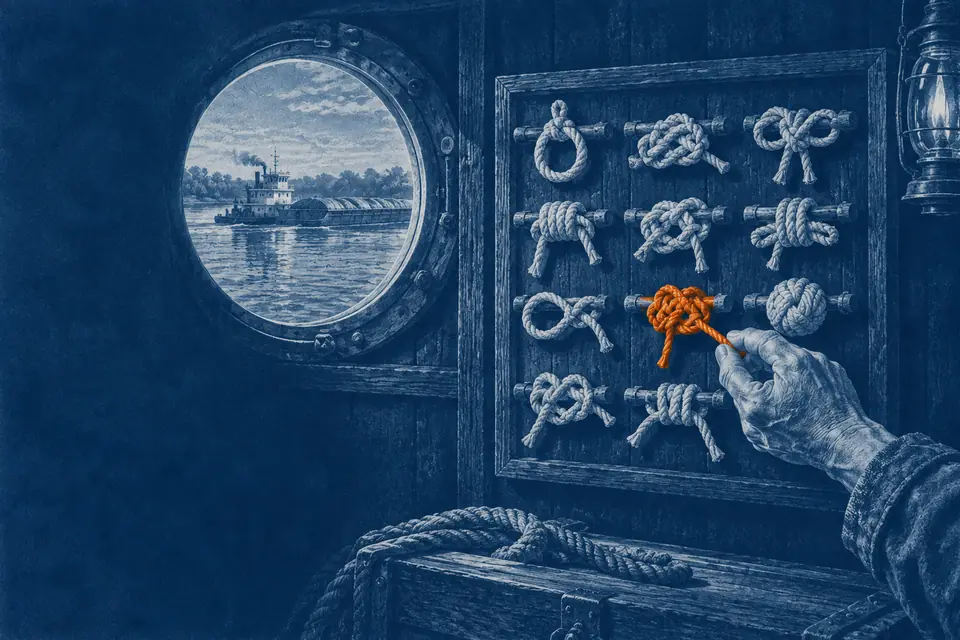
What operations already write down
A freight or river logistics operation produces bills of lading, delivery receipts and proof-of-delivery scans, carrier invoices, customs and hazardous-materials paperwork, EDI exception reports, vessel and deck logs, and dispatch notes. A plant produces work orders in the maintenance system, each with a free-text "action taken" field, along with inspection photos, nondestructive-testing reports, nonconformance reports and corrective actions, standard operating procedures, OEM manuals and years of sensor history.
The free text is where the knowledge lives. The coded failure field on a work order says "mechanical." The note under it says which bearing, which shift, what the tech tried first, and what actually fixed it. Multiply that by fifteen years and several sites and you have a record of how your organization diagnoses problems.
None of it was written for a model. It's full of shorthand, part numbers that changed in a re-numbering, handwriting, and photos with no captions. Getting it ready is mostly patient, expert reading, followed by a lot of computation.
Where operations AI projects start
Use cases we see in logistics, maritime and manufacturing operations, and the service that carries each.
Freight document extraction
Bills of lading, proofs of delivery and carrier invoices parsed into structured records, with confidence scores and a review queue, measured against a hand-keyed test set.
A work-order agent
Rebuild the maintenance workflow as a sandbox with your tools and seeded data, record senior mechanics working real historical faults, and verify the agent's parts and labor codes automatically.
Failure classification from free text
Turn the notes under the dropdown into a consistent failure taxonomy, labeled by your technicians, for a classifier that reads what the code field missed.
Visual inspection annotation
Corrosion, weld defects, hull and deck damage, and damaged freight labeled by experienced inspectors, with a rubric for the borderline cases that decide whether something ships.
Feature pipelines for analytics platforms
Distributed preprocessing of sensor history, work orders and inspection data into features for predictive-maintenance models and the dashboards that sit on them, in your cloud.
Keeping the agent honest after launch
Each month, sample the agent's real tasks, label its failures with your mechanics, and fold them into the next training and evaluation set.
What you have, and what it becomes
| What you have | What it becomes | Where the work is |
|---|---|---|
| Closed work orders with free-text notes | Diagnosis-and-fix examples, a failure taxonomy, and the seed tasks for an agent sandbox | Clean: expanding shorthand with a glossary your technicians approve |
| Bills of lading and proofs of delivery | Structured shipment records and a field-level accuracy report | Parse: stamps, signatures, handwritten corrections |
| OEM manuals and SOPs | A retrieval index the agent can search, with section-level citations | Parse: wiring diagrams, torque tables, scanned pages |
| Inspection and NDT photos | Annotated images with defect class, severity and location | Label: inspector agreement on borderline defects |
| Vessel, deck and shift logs | Event timelines linked to the work orders they triggered | Source: joining records across systems with different asset IDs |
| Sensor and maintenance history | Feature tables for failure prediction, refreshed by a scheduled pipeline | Prove: cost model and monitoring for the pipeline |
Customer terms and export controls
Shipping and manufacturing records often belong partly to someone else. Customer contracts, supplier drawings and carrier agreements can limit how their documents may be used, so the Source gate records the owner and the permission for every collection before anything is trained on it.
For manufacturers in defense and aerospace supply chains, export controls shape who may see technical data. Under the ITAR, 22 CFR 120.50 treats releasing technical data to a foreign person in the United States as a deemed export, and the EAR treats releases of controlled technology the same way at 15 CFR 734.13(b). Our team is made up of US persons and works inside your environment, which simplifies that review but doesn't replace it; your export compliance office decides what is in scope. Controlled unclassified information under defense contracts carries its own safeguarding requirements, which we follow as your environment enforces them.
Benner House is not a law firm and does not provide legal advice.
Questions from operations teams
Our maintenance notes are full of shorthand. Is that a problem?
It's normal. We build a glossary with your technicians in the first weeks, expanding abbreviations and mapping old part numbers to new ones, and that glossary ships with the dataset so the next team doesn't have to rebuild it.
Can an agent be trained without touching production systems?
Yes, and it should be. We rebuild the workflow as a sandbox: a replica of the maintenance system with seeded data, a parts-inventory tool, a manual search tool, and a verifier that checks the agent's answer against what actually fixed the fault. Nothing in the sandbox can write to a live system.
Do you handle handwritten forms and photos of paper?
Yes. We measure field-level accuracy on a hand-keyed sample, route low-confidence fields to human review, and report what share of the archive was readable at all.
Can your team work at our plant or terminal?
Yes. Our team works out of Jackson, Mississippi, and can work on-site at your facility, most easily across the Gulf South. On-site work is useful when records live on local servers or when technicians' time is easier to get in person.
We're in the defense supply chain. Can you work with export-controlled data?
Our staff are US persons, and we work inside your environment under your access controls. Whether a particular dataset may be shared with us, and on what terms, is your export compliance office's decision; we'll provide whatever personnel information that review needs.
Related services and reading
Bring us one messy data source and one question.
Tell us what the data is and what you want a model to do with it. A data engineer, not a salesperson, will reply within one business day with questions and a proposed first step.