
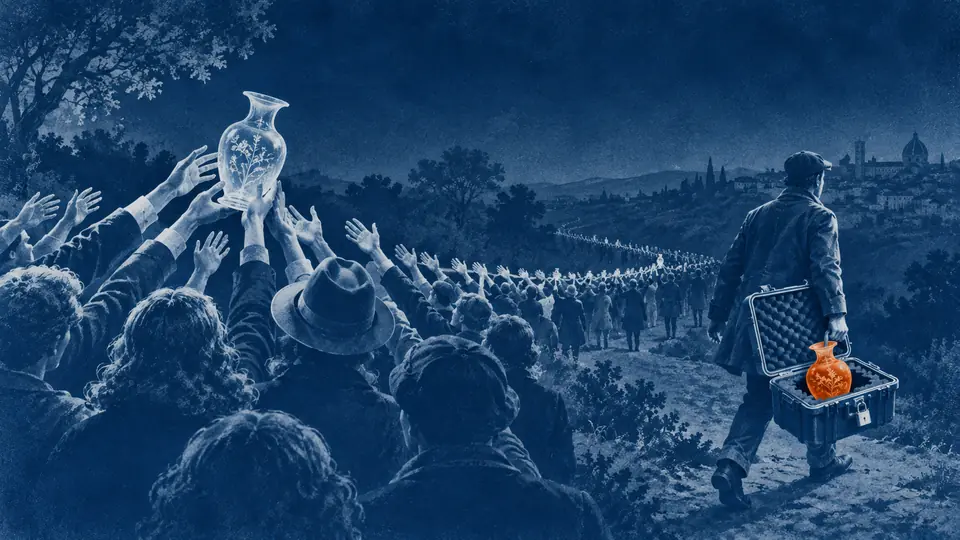
Onshore vs. crowd: when sensitive data needs a US-only data team
When sensitive training data needs a US-only, employed team instead of a crowd: the rules that decide who may see a record, the quality evidence, and a decision table.
AI training data · Jackson, Mississippi
Benner House turns claims notes, work orders, contracts, call recordings and decades of scanned paper into training-grade datasets, evaluation sets and pipelines. Our onshore team works inside your cloud, and every delivery is measured against a test your own experts trust.
Claims note becomes a fine-tuning pair. Raw record, then the training record, then the checks it passed.
claims/2025-q3/batch-114/note-0388.pdf · scanned, 1 page
07/14 Spoke w/ insured (name redacted) (pol. (policy number redacted)) re: roof at (street address redacted), Pass Christian. Wind-driven rain, shingles lifted on S slope, approx 14 sq. Ceiling stain bdrm 2. Policy HO-3, wind deductible 2%. 6 photos rec'd. Roof age 17 yrs, ACV vs RCV on shingles likely. Rec field inspection.
Fine-tuning pair · JSON
{
  "task": "claims_next_step",
  "input": "Wind-driven rain; shingles lifted, south slope,
            ~14 squares; interior stain, bedroom 2; HO-3;
            2% wind deductible; roof age 17 years.",
  "output": "Schedule field inspection. Flag ACV vs. RCV
             on roof shingles. Apply 2% wind deductible.",
  "labels": { "peril": "wind", "severity": "moderate" },
  "pii_removed": 3,
  "reviewer": "adjuster-07"
}Work order becomes a agent trajectory. Raw record, then the training record, then the checks it passed.
cmms/export/2025-10/WO-58817.txt · free text
WO-58817 | Towboat V-14 | Port main engine high coolant temp alarm 2x on upbound run nr Vicksburg. Crew flushed raw-water strainer, alarm cleared. Tech (technician's name redacted) requests coolant analysis + parts check, thermostat TH-2207. Next drydock Nov.
Agent trajectory · JSON
[
  { "tool": "cmms.get_asset", "args": { "id": "V-14" } },
  { "tool": "cmms.search_history",
    "args": { "symptom": "coolant temp high", "days": 180 } },
  { "tool": "inventory.check", "args": { "part": "TH-2207" } },
  { "tool": "inventory.reserve", "args": { "part": "TH-2207" } },
  { "tool": "cmms.create_task",
    "args": { "type": "coolant analysis", "priority": "P2" } },
  { "final": "Part reserved; analysis task opened; recheck
              after next upbound run." }
]Call transcript becomes a preference pair. Raw record, then the training record, then the checks it passed.
calls/2025-09/member-services/c-20931.wav · 6 min
Member: I got a letter saying my MRI was denied, but my doctor said it was approved? Member ID (member ID redacted). Agent: Let me look. I see the prior authorization was approved on the 3rd, but the claim was denied because the facility was out of network. Member: Nobody told me that.
Preference pair · JSON
{
  "prompt": "Member says the MRI claim was denied though
             the doctor said it was approved.",
  "chosen": "Explain auth vs. claim status, confirm the
             network issue, offer a reconsideration.",
  "rejected": "Tell the member to call the doctor's office.",
  "rubric": { "accuracy": 4, "resolution": 4, "tone": 3 },
  "rater": "rn-reviewer-12",
  "panel_agreement": 0.86
}Three real-world shapes of business data, and what each becomes after it passes through the Six Gates. Every name, number and address is invented for the demonstration.
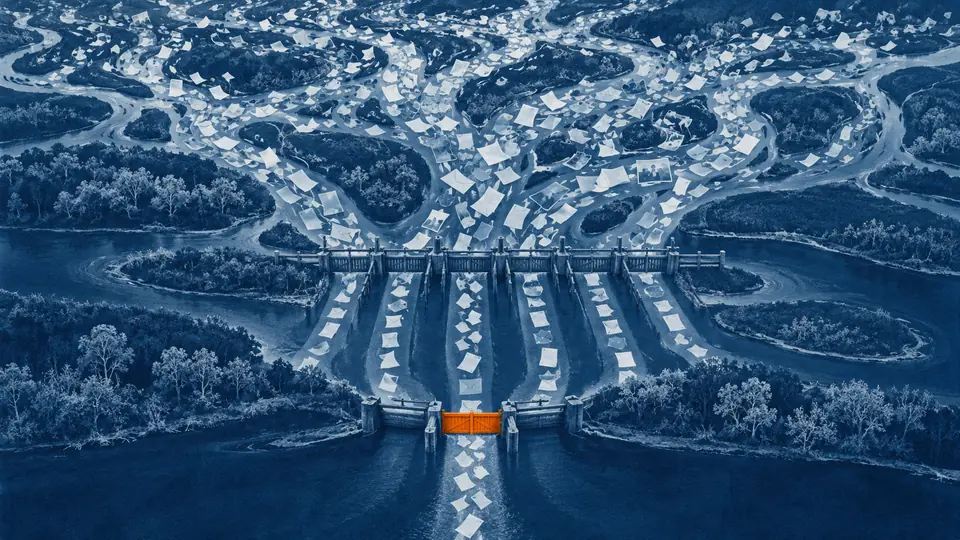
Most organizations are sitting on a delta of records: scanned, duplicated, sensitive, scattered across systems nobody owns. Our work is the weirs and the lock.

The general-purpose models your teams use were trained on what anyone could download. What they have never seen is how your business actually works: the adjuster's reasoning on a disputed roof, the nurse's handoff note, the dispatcher's fix for a stuck barge. That knowledge sits in your systems, mostly unstructured, partly sensitive, and largely unlabeled.
This is why the next round of useful AI is smaller and more specific. Gartner predicts that by 2027 organizations will use small, task-specific models 3× more than general-purpose LLMs, and it names data preparation as the work that makes that possible. The bottleneck isn't the model. It's turning your records into something a model can learn from without leaking what it shouldn't.
Figures from Gartner's research on AI-ready data and small models. Sources are linked on each card.
60%
Of AI projects unsupported by AI-ready data will be abandoned through 2026, Gartner predicts.
Gartner press release, February 26, 202563%
Of organizations either do not have or are unsure if they have the right data management practices for AI.
Gartner press release, February 26, 20253×
Gartner predicts that by 2027 organizations will use small, task-specific AI models at least three times more than general-purpose LLMs.
Gartner press release, April 9, 2025Every engagement moves data through the same channel. Start wherever your bottleneck is.
Inflow Your records: documents, scans, tickets, recordings, tables
Outflow Training-grade datasets, evaluation sets, and pipelines you own
Find what you have, make it machine-readable, and remove what would teach the wrong lesson.
Take out what must never be learned, record where every record came from, and generate what you can't collect.
Turn your experts' judgment into the examples, preferences, and demonstrations that models learn from.
Measure whether it worked, run the heavy processing, and keep the data improving after launch.
Like a flight of river locks, each gate lifts the data one level and holds it there until it passes. Nothing skips a gate. Read the full method.
Inventory every system, owner and right to use.
Make scans, tables, forms and audio machine-readable.
Remove duplicates, junk and anything leaked from your test sets.
Redact or pseudonymize what must never be learned.
Capture your experts' judgment as examples, preferences and demonstrations.
Measure before and after, then write the provenance manifest.
Most data projects are judged by volume: how many records labeled, how many hours transcribed. We judge them by whether the model got better at the task your people care about.
So before we label anything, we build the evaluation: a golden set of real cases your experts agree on, a rubric that says what good looks like, and an automated judge we have calibrated against those experts. Every dataset we deliver comes with a before-and-after score on that test. If a batch doesn't move the number, we say so and change course.
Our analysts and reviewers come from the work itself, so they read your data the way your people do.
We publish a complete sample datasheet and three illustrative engagement blueprints instead of testimonials. They show the deliverables, the checks, and the numbers we report.
Field notes on data readiness, evaluation, agents, and privacy. All articles.
When sensitive training data needs a US-only, employed team instead of a crowd: the rules that decide who may see a record, the quality evidence, and a decision table.
The Digital Omnibus delayed the AI Act's high-risk rules, including Article 10 on data. What is settled, what is pending, and what US data and model vendors owe now.
A worked estimate for embedding 50 million documents: tokens, FLOPs, GPU-hours, padding, storage and index memory, with every assumption stated so you can swap in your own.
Jackson · Gulf South · United States
Our team works from downtown Jackson and travels to client sites across Mississippi, Louisiana, Alabama and Tennessee when the data can't leave the building. We work remotely with clients anywhere in the United States, always in US time zones and always with US-person staff.
Tell us what the data is and what you want a model to do with it. A data engineer, not a salesperson, will reply within one business day with questions and a proposed first step.