
Decades of outage tickets already describe how your system fails, and how your crews fix it.
Utilities keep meticulous records because regulators require them: inspection reports, outage tickets, switching orders, operator logs. Few were written for a machine. We prepare them for AI with background-checked US staff working inside your environment, under the access rules your CIP program already enforces.
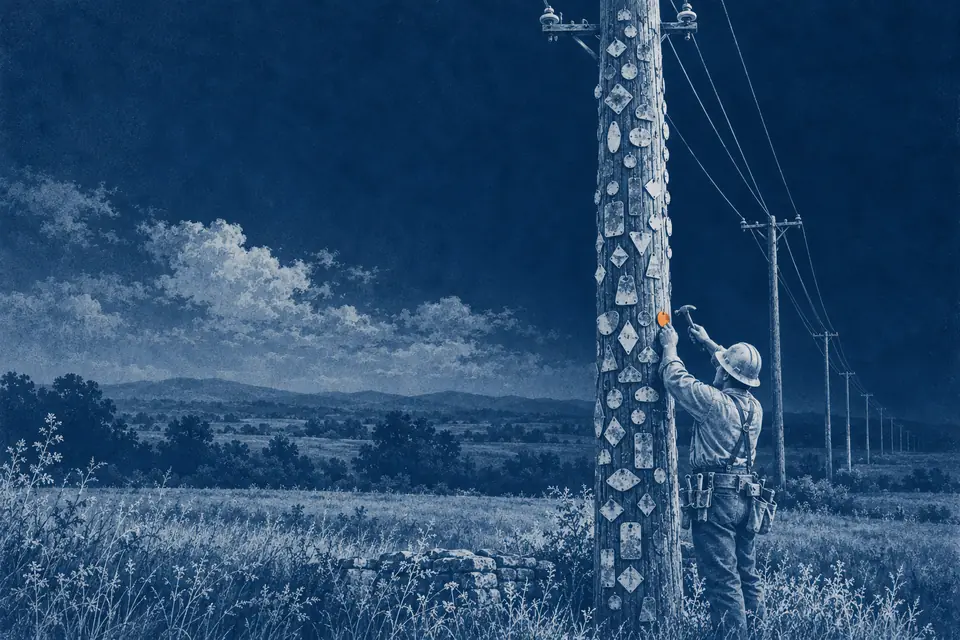
What a utility already records
An electric utility's outage management system holds years of tickets with cause codes and crew remarks. Around it sit storm-restoration logs, switching orders, SCADA alarm histories and control-room operator notes, pole and line inspection records with photos, vegetation-management notes, drone and LiDAR imagery, work-management orders, and call transcripts from every major event. Gas utilities add leak-survey records and integrity reports; generators add plant logs and maintenance histories. Interconnection and large-load requests bring their own applications and studies.
The cause code on an outage ticket is often a best guess entered at the end of a long night. The crew remark under it ("found squirrel on bushing, replaced fuse, ok") is usually closer to the truth. That gap is what a model can learn from, and what an evaluation should test.
The same records are among the most sensitive a company holds. A one-line diagram or a substation photo can matter more to an attacker than a customer list, which is why access rules are settled before any utility work begins.
Where utility AI projects start
Use cases we see at investor-owned utilities, cooperatives, municipal systems and generators, and the service that carries each.
Outage cause classification
Relabel a sample of historical tickets from crew remarks with experienced operators, then train and test a classifier that reads the remark, not just the dropdown.
Inspection photo annotation
Rotted crossarms, cracked insulators, leaning poles and vegetation encroachment labeled by experienced lineworkers and inspectors, with a rubric for the borderline cases.
Procedures assistant for restoration
Parse restoration plans, procedures and past event reports into a retrieval index with citations, and test it on questions your operators actually ask during storms.
Drone and LiDAR imagery at scale
Batch pre-labeling, embedding and indexing of inspection imagery on GPUs in your own cloud or data center, with a cost model before the first run.
Red-teaming an operations assistant
Test that an assistant refuses to produce switching instructions, never reveals protected system details, and says so when the procedures don't cover a situation.
Synthetic fault scenarios
Where the failures you care about are rare, generate synthetic events from real templates and validate them against held-out real cases before anyone trains on them.
What you have, and what it becomes
| What you have | What it becomes | Where the work is |
|---|---|---|
| Outage tickets with crew remarks | A relabeled cause taxonomy and a classifier test set graded by operators | Label: agreement between operators on ambiguous causes |
| Pole and line inspection records with photos | Annotated defect images linked to asset IDs and inspection dates | Source: matching photos to assets after re-numbering |
| Switching orders and operator logs | Event timelines for post-event review and evaluation cases for assistants | Protect: access limited to staff cleared under your CIP program |
| Restoration plans and procedures | A retrieval index with section-level citations | Parse: scanned binders and revision histories |
| Storm call transcripts | Labeled caller intents and a test set for outage-communication assistants | Protect: customer names, addresses and account numbers |
| Drone and LiDAR imagery | Pre-labeled, indexed imagery and a reviewed sample for model training | Prove: GPU cost per thousand images, measured before scaling |
NERC CIP, CEII and who may see what
For registered entities, NERC CIP-004-7 requires a personnel risk assessment before anyone gets authorized electronic or unescorted physical access to high impact BES Cyber Systems (and medium impact systems with external routable connectivity), including a seven-year criminal history records check, and it governs provisioned access to BES Cyber System Information. Separately, FERC's rules at 18 CFR 388.113 cover critical energy infrastructure information: specific engineering, vulnerability or detailed design information about critical infrastructure.
Our team members are US persons who pass background checks before client access, and we follow your personnel risk assessment process for anyone who needs access your program governs. We work inside your environment, or on a workstation at your facility, so system information doesn't leave your control. Scope decisions belong to your CIP program owners.
Benner House is not a law firm and does not provide legal advice.
Questions from utilities
Will your staff go through our personnel risk assessment?
Yes. Anyone on our team who needs access your CIP program governs goes through your process, in addition to our own background check, and you control their access the same way you control any employee's.
Can you work in an isolated or on-premises environment?
Yes. We can work entirely on a workstation inside your facility or on an isolated network segment, with no cloud services involved. It's slower to set up and often the right call for operational data.
Can you handle the volume of drone and LiDAR imagery?
Yes. We design and build the processing pipeline in your cloud or data center: batching, GPU pre-labeling, embedding and indexing, with a cost model and a pilot run before the full archive is processed.
Do you work with cooperatives and municipal utilities?
Yes. Smaller systems often have the same records in fewer, messier places, and a readiness assessment is usually the right first step.
Related services and reading
Bring us one messy data source and one question.
Tell us what the data is and what you want a model to do with it. A data engineer, not a salesperson, will reply within one business day with questions and a proposed first step.